Researchers uncover hidden disease mechanisms in the disordered human proteome
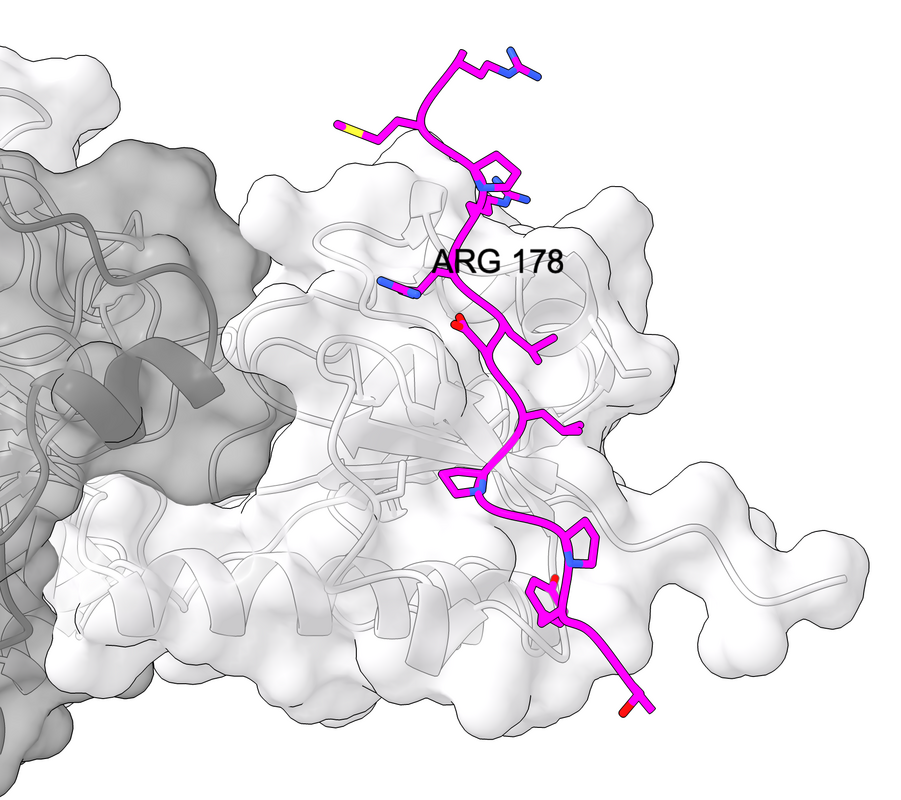
An uncharacterized variant in an IDR.

Dr Katja Luck
The human genome contains millions of inter-individual genetic differences, but determining which ones disrupt biological function—and how—remains a fundamental challenge. Dr Katja Luck and her team at the Institute of Molecular Biology (IMB) in Mainz have developed a new approach to tackle this problem in intrinsically disordered protein regions, which are particularly difficult to study. Combining protein motif analysis with structural modelling, they identified more than 1,000 genetic variants that are likely to have deleterious effects. Their findings, published in Nature Structural & Molecular Biology, offer new leads for understanding the molecular basis of many genetic diseases.
As genome sequencing becomes more common in both research and medicine, researchers are uncovering vast numbers of inter-individual genetic variants in humans. The biggest challenge now lies in identifying which of the many thousands of variants can disrupt protein function in ways that lead to disease. This information is especially important for understanding the mechanisms of rare genetic diseases, where patients often have many uncharacterised genetic variants and it is unclear which contribute to the disease and which are harmless.
More than a third of missense mutations occur in intrinsically disordered protein regions
Katja Luck and her research team set out to address this critical gap between DNA sequence and protein function using a machine learning method that combines protein sequence motif searches and structural modelling of the corresponding regions with AlphaFold. Specifically, the team focused on protein interactions involving intrinsically disordered regions (IDRs), which are flexible stretches in proteins that do not fold into stable three-dimensional shapes, but are nonetheless essential for protein binding and function. IDRs contain 37% of all uncharacterised missense mutations, but they are very difficult to study because most existing tools to predict the effect of missense mutations work best on folded protein regions. As a result, many genetic variants in IDRs remain uncharacterised, creating a significant bottleneck in the study of genetic diseases.
Uncovering which genetic variants disrupt protein binding
For their study, they analysed more than 50,000 published human protein-protein interactions and identified 1,300 interactions involving IDRs, which they structurally annotated. Katja and her team then identified missense variants falling within these interaction regions that are likely to disrupt protein binding, and hence have functional consequences. In total, Katja and her team identified 1,187 potentially pathogenic genetic variants in IDRs. Importantly, they were able to confirm several of these deleterious effects experimentally, including some variants that leading computational tools had predicted to be benign. This showed that even flexible, poorly structured regions of proteins can contain crucial interaction sites whose disruption may contribute directly to disease.
“Most patients that undergo whole genome or exome sequencing remain without a genetic diagnosis because we cannot predict well which of the identified mutations are likely disease-causing. This hinders selection and development of therapies and prohibits a better understanding of the underlying disease mechanisms. Our study is an important step forward in developing tools for clinicians to close this gap.”
- Dr Katja Luck, Group Leader, IMB Mainz
From uncertain genetic variants to testable disease mechanisms
By shedding light on this long-overlooked part of the proteome, Katja and her team have improved our understanding of how human genetic variation connects to functional molecular mechanisms. These findings will be able to help researchers and clinicians better identify disease-causing mutations, particularly in rare disorders, and pave the way towards developing a cure.
Further details
Read the full paper here: https://doi.org/10.1038/s41594-026-01846-z
Katja Luck is a Group Leader at the Institute of Molecular Biology in Mainz. Further information about research in the Luck lab can be found at www.imb.de/luck.
This study was funded by the Ministry of Science and Health, Rhineland Palatinate and Deutsche Forschungsgemeinschaft (German Research Foundation, DFG).
About the Institute of Molecular Biology gGmbH
The Institute of Molecular Biology gGmbH (IMB) is a centre of excellence in the life sciences that was established in 2011 on the campus of Johannes Gutenberg University Mainz (JGU). Research at IMB focuses on the cutting-edge fields of epigenetics, genome stability, ageing and RNA biology. The institute is a prime example of successful collaboration between a private foundation and government: The Boehringer Ingelheim Foundation has committed 154 million euros to be disbursed from 2009 until 2027 to cover the operating costs of research at IMB. The State of Rhineland-Palatinate has provided approximately 50 million euros for the construction of a state-of-the-art building and is giving a further 52 million in core funding from 2020 until 2027. For more information about IMB, please visit: www.imb.de.
Boehringer Ingelheim Foundation
The Boehringer Ingelheim Foundation is an independent, non-profit organization that is committed to promoting the medical, biological, chemical, and pharmaceutical sciences. It was established in 1977 by Hubertus Liebrecht (1931–1991), a member of the shareholder family of the Boehringer Ingelheim company. Through its funding programmes Exploration Grants, Plus 3, and Rise up!, the Foundation supports excellent scientists during critical stages of their careers. It also endows the prestigious Heinrich Wieland Prize and awards for emerging scientists. Additionally, it funds institutional projects combining AI and biomedicine, such as the AITHYRA institute in Vienna and a new research unit at the Center for Systems Biology in Dresden (BioAI Dresden). Other supported institutions include the Institute of Molecular Biology (IMB) in Mainz and the European Molecular Biology Laboratory (EMBL) in Heidelberg, both in Germany.
Press contact for further information
Dr Ralf Dahm, Director of Scientific Management
Institute of Molecular Biology gGmbH (IMB), Ackermannweg 4, 55128 Mainz, Germany
Phone: +49 (0) 6131 39 21455, Email: press(at)imb.de